The UNH Graduate School offers programs and resources to support graduate students and postdoctoral scholars in developing and funding their research. These include internal and external funding opportunities, research awards, professional development workshops, and research communication events, such as UNH’s annual Three Minute Thesis (3MT®) competition and the Graduate Research Conference.
In addition to these opportunities, we know successful research requires writing support, community, and mentorship, and a focus on personal well-being. For formal writing support, join the Moorhead Writing Academy. To build a consistent writing practice, participate in our Weekly Writing Group. To explore mentorship opportunities and resources for self-care, visit our Support and Well-being page. And to continue growing your graduate community, we invite you to join our scheduled gatherings, such as Community Lunch.
-

Ready to turn your research into a world-changing manufacturing technology?
Apply now for the Manufacturing Research Showcase at MIT to compete for $50k in prizes. Hosted by the MIT Initiative for New Manufacturing and the New England I‑Corps Hub, this event brings together the best ideas from across New England to help turn early-stage research into commercial vision.
Apply here by April 6th, 2026.
-

Leitzel Center Awards
"Competing for the Leitzel award was an exciting opportunity to share my work and see other STEM education research from graduate students around the university. I am very grateful to the Leitzel Center for supporting me as a researcher and for their support of Joan and James’ mission for advancing STEM education."
- Dalton Marsh, 2019 Leitzel Award Recipient


Funding Opportunities
There are a variety of award opportunities available through the Graduate School to support and uplift students as they work towards their goals. Available awards include the Dissertation Year Fellowship (DYF), Summer Teaching Assistant Fellowship (STAF), Graduate Faculty Mentor Award, Graduate/Research/Scholarship/Creativity Award (GRSC), and Graduate Teaching Award. Further information about opportunities right here on campus can be found in the Fellowships, Funding, & Awards Available to Grad Students Guide.
The Graduate School awards travel grants to students who are presenting their research and scholarship at professional meetings. Travel grants are also available to students who are attending professional development workshops and seminars that will enhance their research agendas.
The UNH Joan and James Leitzel Center for Mathematics, Science, and Engineering Education offers annual awards at the UNH Graduate Research Conference (GRC) to recognize exemplary STEM education and outreach projects presented at the GRC. The Leitzel Center may grant up to two awards each year.
Award selection is based on the presenter’s demonstration of a significant contribution in at least one of two key areas:
- Graduate student contributions made in the design and implementation of STEM education research projects, which advance our understanding of STEM education.
- Graduate student contributions made in the design and implementation of STEM education outreach projects, which directly impact STEM teachers, instructors and faculty or STEM students of all ages through the application of enhanced STEM content or pedagogies.
Each award is valued at $500. To be considered, presenters must contact Steve Hale at steve.hale@unh.edu to discuss their project and eligibility.
For more information about participating in the UNH Graduate Research Conference (GRC), please explore the GRC webpage.
The UNH Alumni Association Student Grants Committee awards grants to provide funds to UNH students, either as individuals or in groups, on campus for extracurricular activities and/or extraordinary student needs that otherwise would not be provided for. Grant funding is provided by the funds raised from the Alumni & Friends Wildcat Classic Golf Tournament which are directly applied to the J. Gregg Sanborn Enrichment Fund.
The Sustainability Fellowship pairs exceptional UNH undergraduate students and post-baccalaureates (grad students and recent grads) from UNH with municipal, educational, corporate, and non-profit partners to work on transformative sustainability projects. Each summer, Fellows undertake challenging sustainability projects that are designed to create an immediate impact, offer an extraordinary learning experience, and foster meaningful collaboration.
- Work with municipal, educational, corporate, and non-profit partners
- Connect with a growing network of sustainability leaders (mentors, advisors, alumni, and peers)
- Learn through hands-on experience and professional development
- Build resilience across New England and beyond
- Earn $10,000 (post-baccalaureates) or $6,500 (undergraduates)
Looking to take your research, graduate study, or teaching abroad?
Apply to the Fulbright US Student Program, which provides funding for 8–10 months of independent research, graduate-level study, or English teaching in over 140 countries. Grants typically include roundtrip airfare, a living stipend, and health insurance, and may make recipients eligible for student loan deferment. The next application cycle has deadlines in August/October 2026, with most grants beginning in Fall 2027.
To learn more, register for an upcoming information session. Sessions will be held in late March and early April 2026, with both remote and in-person attendance options available.
Further application support will be provided by the Office of National Fellowships, offering individualized feedback through scheduled advising meetings, drop-in hours, and email correspondence on draft materials.
For questions, contact Leigh Pratt, Director of the UNH Office of National Fellowships, at leigh.pratt@unh.edu.
Students at the University of New Hampshire have a strong track record of success: UNH has been named a 2026 Fulbright Top Producer, earning recognition for being one of the colleges and universities with the highest number of students and recent alumni selected for the program!
The Switzer Fellowship Program supports students who have a commitment to improving the environment and who demonstrate leadership and problem solving skills. Twenty one-year $17,000 awards for academic expenses as well as networking and leadership support are awarded each year: ten in California and ten in New England. Applicants must be U.S. citizens, permanent residents, DACA recipients, or refugees or asylum seekers (per the US Department of Homeland Security definition).
Applications closed January 5, 2026 by 11:59 pm PST and will reopen in 2027. The Office of National Fellowships can support you with developing your application materials and obtaining your official transcript; reach out to Leigh Pratt at national.fellowships@unh.edu for support with your application.
The Environmental Business Council of New England (EBC) is pleased to offer a scholarship of $2,500 for students currently enrolled in an accredited New England 2- or 4-year program pursuing a degree related to the environmental or energy fields, applicable for the 2026-2027 academic year.
The submission deadline for all scholarship applications is 5:00 pm on Sunday, March 22, 2026.
Recipients will be notified of their status later this Spring 2026. Awardees will be invited to the EBC Summer Garden Party in August 2026 to formally receive the scholarship.
Research Communication Events
The Three Minute Thesis Competition cultivates students’ academic, presentation, and research communication skills. Presenting in a 3MT competition increases their capacity to effectively explain their research in three minutes, in a language appropriate to a non-specialist audience. Competitors are allowed one PowerPoint slide, but no other resources or props.
The Graduate School facilitates a workshop series designed to help participants prepare for the 3MT competition. From brainstorming your presentation content to honing your public speaking skills, these workshops guide you through all necessary steps for a successful 3MT. More information on the workshop series will be shared with selected participants at the start of the Spring semester.
Applications will reopen in Fall 2026 for the Spring 2027 Competition. Be sure to read the Graduate Student Newsletter sent via email for updates. Reach out to grad.assist@unh.edu with any questions.
The Graduate Research Conference is an annual, two-day showcase in which over 200 UNH graduate students from all academic disciplines present their work and research. Visit the GRC Student Research Media Gallery where students upload their GRC research for online viewing.
The GRC typically occurs in April each year, with registration beginning in February. Be sure to read the Graduate Student Newsletter sent via email for updates. Reach out to grad.assist@unh.edu with any questions.
The Innovation Lunch and Learn Series is a six-part, interactive series designed to guide faculty and graduate researchers through key aspects of the innovation journey, from securing non-traditional funding and protecting intellectual property to building industry partnerships and launching faculty-led ventures. Each session is designed to be practical, accessible, aligned with your research mission, and will highlight support available to you through UNH Innovation.
Session Topics & Dates:
- Nov 20, 2025 – Finding Funding: Non-traditional Grants for Innovation-Driven Research
- Dec 18, 2025 – Beyond the Journal: Turning Research into Real-World Solutions
- Jan 29, 2026 – Faculty Innovator’s Playbook: Research Entrepreneurship Mindset
- Feb 19, 2026 – Innovation Starts Here: UNH Resources that Power Your Research
- Mar 12, 2026 – Collaborate to Innovate: Building Industry-Research Partnerships
- Apr 23, 2026 – Ideas with Equity: Licensing, Ventures & Faculty-Led Startups
All sessions will be held from 12:30 pm - 1:30 pm in the Thompson Hall Board of Trustees Room and available virtually.
Please register to attend: https://innovation.unh.edu/lunch-learn.
Generative AI in Research: A Faculty Panel Workshop
Tuesday, March 24, 2026, 3:40-5:00pm via Zoom
Designed for researchers at all stages, this engaging workshop provides an opportunity to exchange perspectives on the evolving role of generative AI in research, featuring a panel of UNH researchers
who will share how they use generative AI tools in their scholarly work.
Register to attend. To learn more about the event, click here.
About the Series:
Each academic year, RCR workshops are offered on the theme, Research Integrity from Inception through Dissemination, addressing issues that arise during the life cycle of a research study. Information about upcoming workshops can be found here when they become available. At the bottom of the webpage, you will find the RCR Workshop Library containing videos and associated materials from past offerings.
This workshop series is sponsored by The Responsible Conduct of Research & Scholarly Activity Committee, the Office of Research and Innovation, and the Graduate School.
Grab and drink and learn what's going in the local scientific community! You're invited to Seacoast Sips of Science, an ongoing series of events where scientists host meet-ups at New Hampshire breweries and talk about their research! Check out the event calendar here.
Calling all UNH graduate students! Are you interested in expanding your innovation skills? Want to test your idea with a real-world audience? Join an NSF I-Corps training!
UNH Innovation invites you to learn more about the New England Regional I-Corps SPARK Program, hosted in partnership with MIT. The NSF I-Corps program is a customer discovery initiative designed to help researchers commercialize their new technology by understanding market needs and customer feedback, with the opportunity for $2M in non-dilutive innovation funding.
To learn more about this valuable program, join one of the upcoming information sessions.
Questions? Contact unh.innovation@unh.edu.
The ICPSR Summer Program in Quantitative Methods aims to increase access to statistical methods training for students of all different backgrounds and provide the next generation of researchers with the skills, knowledge, and connections they need to do innovative, impactful work.
There will be 90+ in-person or online classes in statistics, quantitative methods, & data analysis. Whether live or asynchronous, class materials will remain available through December 31, 2026.
Applications are due March 1, 2026. Scholarships are available for applicants.
Research Standards
The Office of Research, Economic Engagement, and Outreach at the University of New Hampshire, a Carnegie doctoral research university with very high research activity, seeks to understand and improve the world around us, with high-impact results that transform lives, solve global challenges and drive economic growth.
As a land-grant institution, the University of New Hampshire (UNH) is accountable to New Hampshire residents and to the university community to ensure the ethical and safe conduct of research and scholarly activity. As an institution of higher education that prides itself on extensive research endeavors and the involvement of undergraduates and graduate students in research projects, UNH has an obligation to teach and actively promote integrity in research and scholarship.
To fulfill its obligations, UNH has embarked on a program on the responsible conduct of research and scholarly activity (RCR) to:
- Raise the consciousness of faculty, staff, and students regarding the ethical and responsible conduct of research and scholarly activity,
- Establish a knowledge base that defines normative and/or professional behavior to assist faculty, staff, and students in making ethical and responsible decisions in the conduct of research and scholarly activity, and
- Foster an institutional culture of integrity in research and scholarly activity encompassing all stages of individuals' careers.
In February 2019, the University of New Hampshire (UNH) Responsible Conduct of Research and Scholarly Activity (RCR) Committee endorsed the American Geophysical Union’s (AGU) Code of Conduct (Section III, pages 4-6).
unh policy on misconduct in scholarly activity
unh policy on discrimination and discriminatory harassment
For more information on these policies, please visit the Responsible Conduct of Research & Scholarly Activity page.
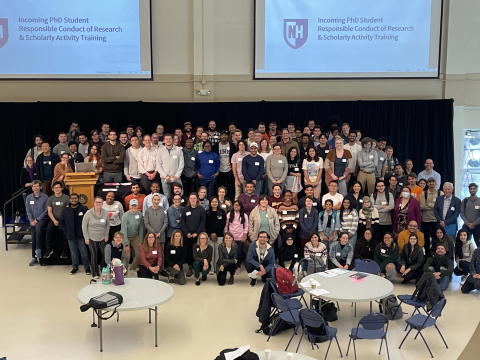
The UNH RCR Committee offers training in the ethical and responsible conduct of research three times a year: February, May and October. All incoming Ph.D. students must attend RCR training by the end of their first semester.
Academic honesty is a core value at the University of New Hampshire. The members of its academic community both require and expect one another to conduct themselves with integrity. This means that each member will adhere to the principles and rules of the University and pursue academic work in a straightforward and truthful manner, free from deception or fraud. The academic honesty policy, including specific sections for graduate students, can be found on the Students Rights, Rules, and Responsibilities webpage.
The UNH Research Office Knowledge Base is designed expressly to support UNH faculty and graduate researchers throughout the research development life cycle. Use the filter tools to access forms, instruction and training material, committee minutes, policies, tools and other resources to support your research efforts by topic area.
